

How can a correlation be determined?
Or how to do a correlation
To establish a site-specific correlation between the static plate load test according to DIN 18134 and the dynamic testing method using a Light Weight Deflectometer (LWD), a test section must be constructed.
Field tests are carried out on this test section under actual site conditions. The objective is to determine the optimum layer thicknesses and the required number of compaction passes with a roller or vibratory compactor. For each layer, the specified degree of compaction and/or the required bearing capacity or stiffness must be achieved.
The field trial should simulate the actual construction conditions as closely as possible. It must be performed for each material type intended for use in the respective road construction project. Particular attention should be paid to layer thickness, placement height, moisture content, material composition, and the type of compaction equipment used.
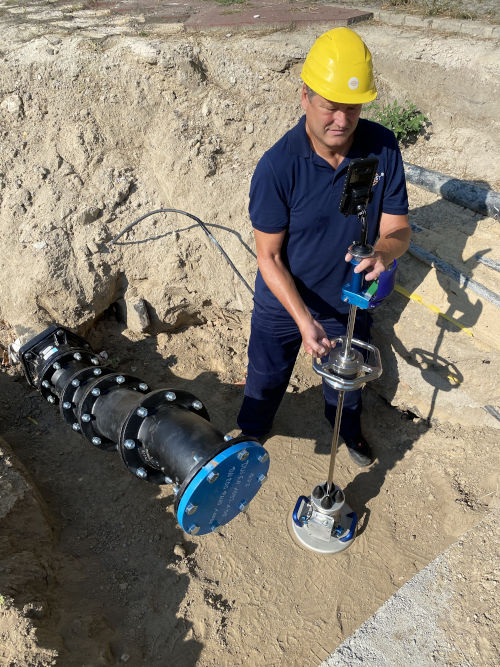
Testing with the TERRATEST 9000 LWD
During routine construction quality control, the LWD may be used as a rapid testing method, provided that a correlation for the respective materials and layers has previously been established on a test section.
The correlation is determined by comparing the results obtained with the Light Weight Deflectometer (LWD) to reference values such as dry density (Proctor density) or the deformation modulus obtained from the static plate load test.
The established correlations can only be considered reliable if sufficient homogeneity exists within each layer with respect to material properties, layer thickness, moisture content, and layer structure. In addition, the different measuring depths of the respective test methods must be taken into account. Measurements on overlapping roller tracks should be avoided, as they may distort the correlation.
Reliable correlations can generally be established by comparing at least 10 different test locations within the test section. For each location, the average value of several repeated measurements should be used. Areas with both high and low bearing capacities should deliberately be included in order to obtain a meaningful correlation.
What should the test section look like?
The test section should be level, sufficiently large, and representative of the final structure. The width of the test section should be at least three times the width of the compaction roller.
The material should be placed in uniform layer thicknesses. Alternatively, different layer thicknesses may be used if the objective is to determine the optimum layer thickness. Compaction must be carried out uniformly and in a controlled, reproducible manner.
For each material type and construction variant, control measurements should be performed after several compaction passes, for example after 4, 6, and 8 passes.
All test results must be fully documented in a test report. This report serves as evidence for quality control, contractor self-monitoring, and final acceptance of the works.
Various testing standards and specifications explicitly recognize the LWD as an approved rapid testing method. However, the required acceptance criteria are generally not specified as fixed values. Instead, they must be established on a project-specific basis through correlation with reference tests performed on a representative test section.
The established correlations can only be considered reliable if sufficient homogeneity exists within each layer with respect to material properties, layer thickness, moisture content, and layer structure. In addition, the different measuring depths of the respective test methods must be taken into account. Measurements on overlapping roller tracks should be avoided, as they may distort the correlation.
Reliable correlations can generally be established by comparing at least 10 different test locations within the test section. For each location, the average value of several repeated measurements should be used. Areas with both high and low bearing capacities should deliberately be included in order to obtain a meaningful correlation.